
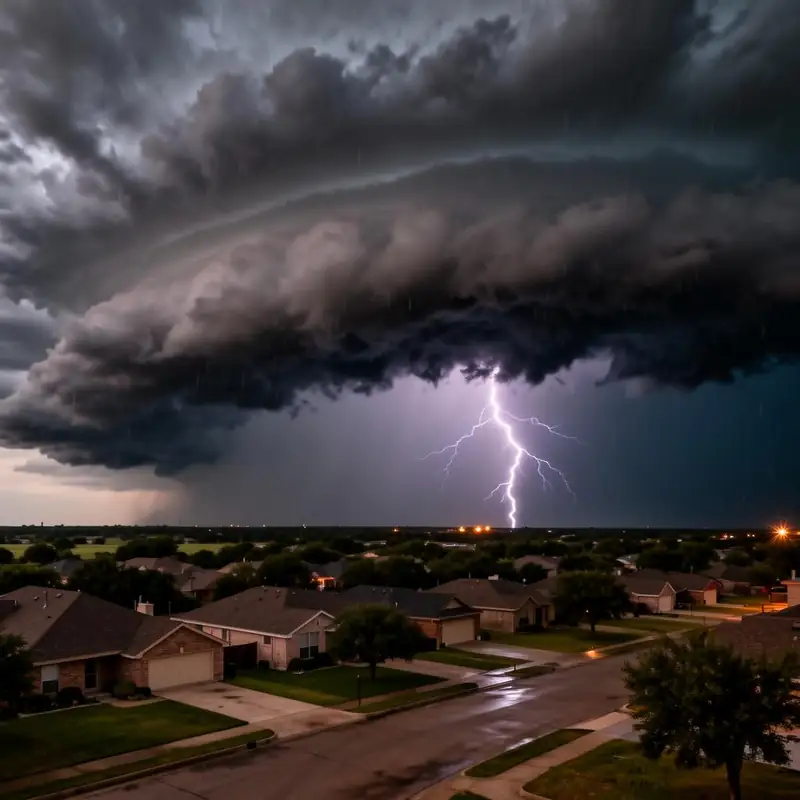
Central Texas hail history by city.
Where the hail belt actually runs through Bell, McLennan, Williamson and Travis counties — what season, what stone size, and what it means for your roof.
Central Texas sits at the southern end of the corridor sometimes called "hail alley." Dryline storms fire west of I-35 in spring, mature as they track east, and drop their largest stones somewhere between Killeen and Waco. That is not evenly distributed — Bell and McLennan counties absorb far more severe hail reports than Travis County does, and within a single city the damage footprint is often only a few miles wide.
The table below is how we brief homeowners before an inspection. It comes from NOAA Storm Prediction Center severe hail reports for these counties combined with our own claim volume by city. Use it to understand your risk — but always verify the swath at your specific address before filing anything.
Hail by city across Central Texas.
| City | County | Hail belt | Peak season | Typical stone |
|---|---|---|---|---|
| Temple, TX | Bell County | Core | March – May | 1" – 2" (quarter to hen egg) |
| Belton, TX | Bell County | Core | March – May | 1" – 1.75" |
| Killeen, TX | Bell County | Core | March – June | 1" – 2.5" |
| Harker Heights, TX | Bell County | Core | March – May | 1" – 2" |
| Nolanville, TX | Bell County | Core | March – May | 1" – 1.75" |
| Salado, TX | Bell County | Edge | March – May | 0.75" – 1.5" |
| Hewitt, TX | McLennan County | Core | April – June | 1" – 2.75" |
| Robinson, TX | McLennan County | Core | April – June | 1" – 2.5" |
| Georgetown, TX | Williamson County | Edge | March – May | 0.75" – 1.75" |
| Cedar Park, TX | Williamson County | Edge | March – May | 0.75" – 1.5" |
| Pflugerville, TX | Travis County | Occasional | March – May | 0.75" – 1.5" |
| Austin, TX | Travis County | Occasional | March – May | 0.75" – 2" |
What each city actually sees.
Temple, TX
Sits in the heart of the Bell County hail corridor. Supercells forming along the dryline routinely mature right as they cross I-35 here.
Hail damage repair in TempleBelton, TX
South end of the same corridor. Belton frequently takes the same cell as Temple 10–15 minutes later, often with higher wind.
Hail damage repair in BeltonKilleen, TX
Wide footprint means storms often hit half the city. Two homes four miles apart can have completely different claim outcomes.
Hail damage repair in KilleenHarker Heights, TX
Cells tracking east along US-190 from Killeen pass directly over the Heights before reaching Nolanville.
Hail damage repair in Harker HeightsNolanville, TX
Almost always affected when Killeen and Harker Heights are, but inspected far less often — a lot of unclaimed damage sits here.
Hail damage repair in NolanvilleSalado, TX
Caught between the Bell and Williamson tracks. Gets clipped by both, rarely takes a direct core hit.
Hail damage repair in SaladoHewitt, TX
McLennan County has produced several of the largest recent stone reports in the region. Claims here tend to be well supported by NOAA records.
Hail damage repair in HewittRobinson, TX
Same cells as Hewitt and south Waco. Outbuilding and shop damage is commonly overlooked in Robinson claims.
Hail damage repair in RobinsonGeorgetown, TX
Frequent smaller-stone, high-density events — the kind that strips granules without cracking shingles. Real damage, commonly missed by walk-by inspections.
Hail damage repair in GeorgetownCedar Park, TX
Western edge of Austin-metro cells. Wind damage is frequently the stronger part of the claim here, not hail.
Hail damage repair in Cedar ParkPflugerville, TX
Storms are less frequent but the housing stock is dense and same-age, so a single event produces hundreds of claims at once.
Hail damage repair in PflugervilleAustin, TX
Highly neighborhood-dependent. Always verify the hail swath at your exact address before filing — city-wide assumptions cause denied claims.
Hail damage repair in AustinHail questions we get every spring.
When is hail season in Central Texas?
Peak hail season across Bell, McLennan and Williamson counties runs March through May, with a secondary window in June. Roughly 80% of the storm claims we handle originate from events in that spring window.
How big does hail need to be to damage a roof?
One inch — quarter size — is the usual threshold for functional damage on standard asphalt shingles, though older or already-weathered roofs can bruise at 3/4 inch. Metal roofs may cosmetically dent at those sizes without any loss of function.
How do I check if my address was hit by hail?
NOAA's Storm Prediction Center publishes dated severe hail reports by county, and carriers use commercial swath data built from radar. We pull the swath for your exact address before recommending a claim, because filing on a storm that missed your street is how claims get denied.
Can I still file for a hail storm from last year?
Usually yes. Texas policies generally require prompt notice and most carriers enforce a one-to-two-year window from the date of loss. The longer you wait, the easier it becomes for a carrier to attribute the damage to wear and tear instead.
Does hail damage always leak?
No — and that is the trap. Hail bruising strips granules and shortens the mat's life without producing a leak for years. By the time it leaks, the claim window on the original storm has usually closed.